
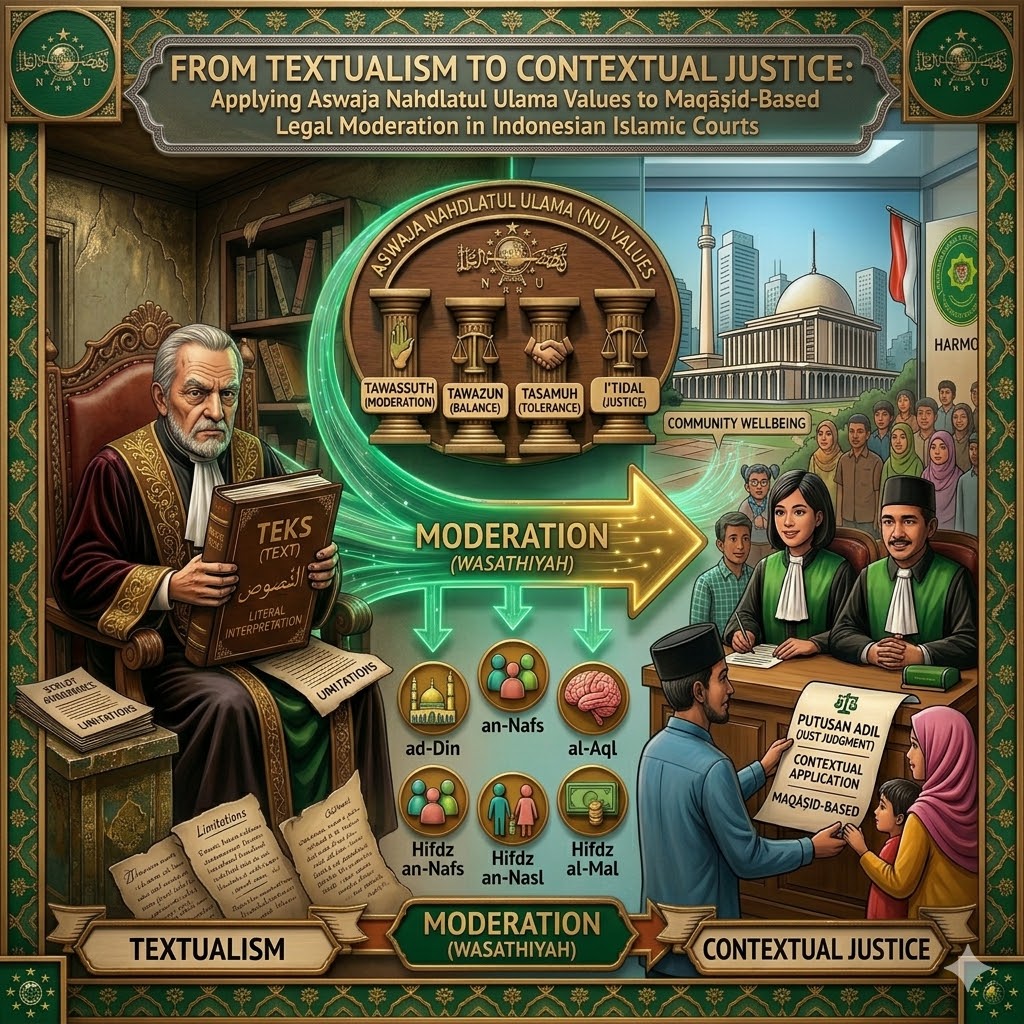
From Textualism to Contextual Justice: Applying Aswaja Nahdlatul Ulama Values to Maqāṣid-Based Legal Moderation in Indonesian Islamic Courts
DOI:
https://doi.org/10.35672/jnus.v7i1.1-14Keywords:
Constitutional Maqāṣid, Legal Moderation, Islamic Courts, Contextual Justice, Judicial ReasoningAbstract
This article offers a novel reconstruction of legal reasoning in Indonesian Islamic courts by proposing a Constitutional Maqāṣid framework that bridges the long-standing tension between textualism and contextual justice. While existing adjudicative practices often oscillate between rigid adherence to statutory texts and fragmented contextual considerations, this study argues that both approaches remain insufficient to address the complexity of contemporary socio-legal realities. The novelty of this research lies in the integration of maqāṣid al-sharīʿah with constitutional values particularly justice, human dignity, and legal certainty into a unified interpretive model termed Constitutional Maqāṣid Justice (CMJ). Employing a normative juridical method combined with conceptual and statutory approaches, this study critically examines judicial reasoning patterns within Indonesian Islamic courts and identifies a persistent gap between formal legality and substantive justice. The proposed CMJ framework repositions judges not merely as appliers of legal texts, but as ethical interpreters who harmonize Qur’anic objectives, statutory provisions, and constitutional mandates. Through this synthesis, maqāṣid principles such as the protection of religion, life, intellect, lineage, and property are elevated from moral guidance to operative constitutional reasoning tools. The findings demonstrate that the Constitutional Maqāṣid approach enables a more adaptive, proportional, and humanistic form of legal moderation. It ensures that judicial decisions remain legally grounded while being socially responsive and normatively transformative. Furthermore, this model contributes a new theoretical paradigm within Islamic legal studies by embedding maqāṣid within a constitutional framework, thus advancing a form of Islamic sociological jurisprudence that is both context-sensitive and institutionally legitimate. Ultimately, this research not only enriches the discourse on legal moderation in Muslim societies but also offers a practical blueprint for reforming judicial reasoning in pluralistic constitutional systems like Indonesia.
References
Ado, S., Salama, M. A., & Abdallah, A. S. (2025). The Maqasid al-Shari’ah and the Protection of Family Economics in Islamic Law: A Reflection on Surah al-Baqarah 2: 188. QURU’: Journal of Family Law and Culture, 3(3), 264-282. https://doi.org/10.59698/quru.v3i3.477
Alexy, R. (2002) A theory of constitutional rights. Oxford: Oxford University Press. https://doi.org/10.1093/acprof:oso/9780198258216.001.0001
An-Na‘im, A.A. (2008) Islam and the secular state: Negotiating the future of Shari‘a. Cambridge, MA: Harvard University Press. https://doi.org/10.2307/j.ctv1pncp0p
Auda, J. (2008) Maqasid al-shariah as philosophy of Islamic law: A systems approach. London: The International Institute of Islamic Thought. https://doi.org/10.2307/j.ctvk8w1zv
Azra, A. (2019) ‘Indonesian Islam in a global context: The moderation of Islam’, Journal of Indonesian Islam, 13(2), pp. 210–230. https://doi.org/10.15642/JIIS.2019.13.2
Bedner, A. (2013) ‘Indonesian legal scholarship and jurisprudence as an obstacle for transnational law reform’, Leiden Journal of International Law, 26(1), pp. 1–22. https://doi.org/10.1017/S0922156512000656
Bowen, J.R. (2003) Islam, law and equality in Indonesia: An anthropology of public reasoning. Cambridge: Cambridge University Press. https://doi.org/10.1017/CBO9780511499449
Dworkin, R. (1977) Taking rights seriously. Cambridge, MA: Harvard University Press. https://doi.org/10.2307/j.ctvjf9wqg
El Fadl, K.A. (2001) Speaking in God’s name: Islamic law, authority and women. Oxford: Oneworld Publications.
Esposito, J.L. and DeLong-Bas, N.J. (2001) Women in Muslim family law. 2nd edn. Syracuse: Syracuse University Press.
Feldman, N. (2008) The fall and rise of the Islamic state. Princeton: Princeton University Press. https://doi.org/10.1515/9781400828234
Hallaq, W.B. (1997) A history of Islamic legal theories: An introduction to Sunni usul al-fiqh. Cambridge: Cambridge University Press. https://doi.org/10.1017/CBO9780511806797
Hart, H.L.A. (1994) The concept of law. 2nd edn. Oxford: Oxford University Press.
Hirschl, R. (2010) Constitutional theocracy. Cambridge, MA: Harvard University Press. https://doi.org/10.4159/harvard.9780674052819
Hooker, M.B. (2008) ‘Indonesian syariah: Defining a national school of Islamic law’, Singapore Journal of Legal Studies, pp. 40–65. https://doi.org/10.2139/ssrn.1316738
Hosen, N. (2007) Shari‘a and constitutional reform in Indonesia. Singapore: Institute of Southeast Asian Studies. https://doi.org/10.1355/9789812304674
Kamali, M.H. (2008) Shari‘ah law: An introduction. Oxford: Oneworld Publications. https://doi.org/10.3366/edinburgh/9780748627943.001.0001
Lindsey, T. (2012) ‘Islamic law and the Indonesian legal system’, in Feener, R.M. and Cammack, M. (eds.) Islamic law in contemporary Indonesia. Cambridge, MA: Harvard University Press, pp. 43–67.
MacCormick, N. (2005) Rhetoric and the rule of law: A theory of legal reasoning. Oxford: Oxford University Press. https://doi.org/10.1093/acprof:oso/9780198268796.001.0001
March, A.F. (2009) Islam and liberal citizenship: The search for an overlapping consensus. Oxford: Oxford University Press. https://doi.org/10.1093/acprof:oso/9780199567683.001.0001
Menski, W. (2006) Comparative law in a global context: The legal systems of Asia and Africa. 2nd edn. Cambridge: Cambridge University Press. https://doi.org/10.1017/CBO9780511610714
MuhdhoriAhmad (2022) ‘Reconstructing Islamic legal reasoning in Indonesian courts’, Journal of Islamic Legal Studies, 5(2), pp. 100–120.
Nurlaelawati, E. (2010) Modernization, tradition and identity: The Kompilasi Hukum Islam and legal practice in Indonesian religious courts. Amsterdam: Amsterdam University Press. https://doi.org/10.5117/9789089640888
Nyazee, I.A.K. (2000) Islamic jurisprudence (usul al-fiqh). Islamabad: Islamic Research Institute.
Otto, J.M. (2010) Sharia incorporated: A comparative overview of the legal systems of twelve Muslim countries in past and present. Leiden: Leiden University Press. https://doi.org/10.5117/9789087280574
Rahman, F. (1982) Islam and modernity: Transformation of an intellectual tradition. Chicago: University of Chicago Press.
Sardar, Z. (2009) Reading the Qur’an: The contemporary relevance of the sacred text of Islam. Oxford: Oxford University Press.
Sunstein, C.R. (1999) One case at a time: Judicial minimalism on the Supreme Court. Cambridge, MA: Harvard University Press.
Tushnet, M. (2009) Weak courts, strong rights: Judicial review and social welfare rights in comparative constitutional law. Princeton: Princeton University Press. https://doi.org/10.1515/9781400828159
Voll, J.O. (2007) ‘Islamic law and the challenge of modernity’, Journal of Islamic Studies, 18(1), pp. 85–90. https://doi.org/10.1093/jis/etl062
Downloads
Published
How to Cite
Issue
Section
License
Copyright (c) 2026 Ahmad Muhamad Mustain Nasoha, Ari Hikmawati, Ashfiya Nur Atqiya, Zamzam and Ar Rahbin, Muhammad Nur Ukasyah, Viror Ghufron Assaifi, Imam Abdullah

This work is licensed under a Creative Commons Attribution-ShareAlike 4.0 International License.




.png)