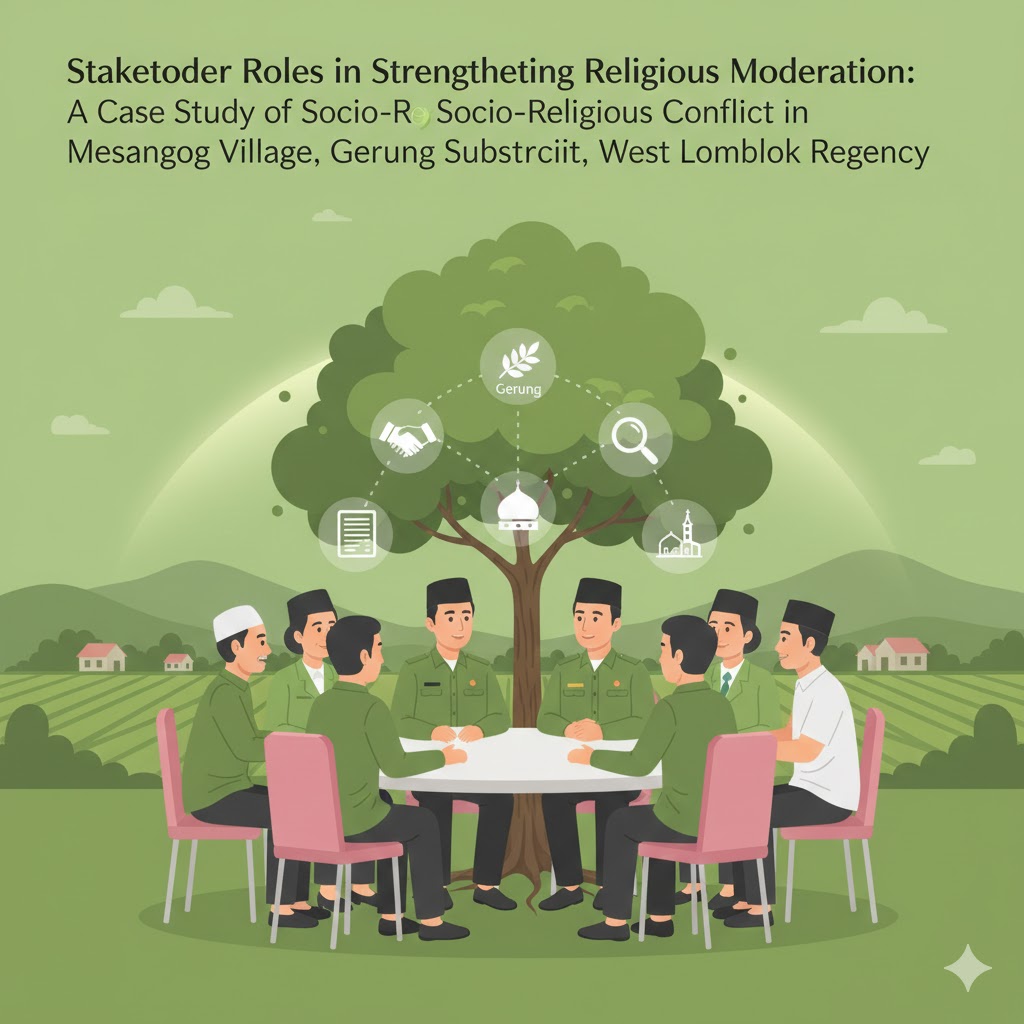
Stakeholder Roles in Strengthening Religious Moderation: A Case Study of Socio-Religious Conflict in Mesanggok Village, Gerung Subdistrict, West Lombok Regency
DOI:
https://doi.org/10.35672/jnus.v6i1.68-85Keywords:
Stakeholders, Religious Moderation, Musyawarah, Collaborative Governance, Socio-Religious Conflict, West LombokAbstract
Religious moderation denotes a perspective, disposition, and practice of religiosity that foregrounds justice, balance, respect for human dignity, and commitment to the national civic compact. Yet in rural communities with entrenched religious traditions, the entry of preaching currents that label local practices as bid‘ah may generate delegitimation, polarization, and conflict escalation. This article addresses three questions: (1) how the chronology and dynamics of socio-religious conflict escalation unfolded in Mesanggok Village, Gerung Subdistrict, West Lombok; (2) how stakeholders (village government, police, the Indonesian Ulama Council/MUI, the Office of Religious Affairs/KUA, the Religious Harmony Forum/FKUB, Lakpesdam NU, religious counsellors, faith-based organizations, youth, and academics) contributed to strengthening religious moderation and post-conflict recovery; and (3) how cross-actor musyawarah (deliberative consultation) produced consensus and programmes to prevent recurrent conflict. Using a qualitative case-study design, data were collected through observation, in-depth interviews, document review, community deliberations (sarasehan), and focus group discussions, and were analysed thematically and iteratively through coding and case-narrative construction with source and method triangulation. The findings show that stakeholder collaboration operated through four stages: (1) de-escalation and security protection, (2) mediated dialogue and norm clarification, (3) the formation of community consensus and rules of engagement, and (4) the institutionalisation of inclusive religious programmes (routine cross-group study circles) that frame differences as manageable khilāfiyah (legitimate interpretive disagreement) rather than identity-threatening disputes. In conclusion, the Mesanggok conflict emerged not merely from theological disagreement but from struggles over legitimacy and the delegitimation of local religious traditions. Recovery proved most effective when religious moderation was enacted through collaborative, deliberative governance that distributed stakeholder roles protection, mediation, norm production, and programme institutionalization in a synergistic and sustained manner. The study recommends: establishing inclusive village-level deliberation protocols; strengthening public literacy on ikhtilāf and the ethics of da‘wah through MUI, KUA, Lakpesdam NU, religious counsellors; developing mediation-oriented community policing; and extending cross-group programmes to the hamlet/RT level to prevent renewed escalation.
References
Affan, H. (2016) ‘Aliran Wahabi dan wajah Islam moderat di Indonesia’, BBC News Indonesia, 19 May.
Ansell, C. and Gash, A. (2008) ‘Collaborative governance in theory and practice’, Journal of Public Administration Research and Theory, 18(4), pp. 543–571. doi:10.1093/jopart/mum032.
Aswar, H. (2016) ‘Politik luar negeri Arab Saudi dan ajaran Salafi-Wahabi di Indonesia’, JISIERA: The Journal of Islamic Studies and International Relations, 1(1).
Badan Litbang dan Diklat, Kementerian Agama Republik Indonesia (2019) Tanya Jawab Moderasi Beragama. Jakarta: Kementerian Agama RI.
Bercovitch, J. and Jackson, R. (2009) Conflict Resolution in the Twenty-First Century: Principles, Methods, and Approaches. Ann Arbor, MI: University of Michigan Press.
Bowen, G.A. (2009) ‘Document analysis as a qualitative research method’, Qualitative Research Journal, 9(2), pp. 27–40.
Cederroth, S. (1981) The Spell of the Ancestors and the Power of Mekkah: A Sasak Community on Lombok. Göteborg: Acta Universitatis Gothoburgensis.
Creswell, J.W. and Poth, C.N. (2018) Qualitative Inquiry & Research Design: Choosing Among Five Approaches. 4th edn. Thousand Oaks, CA: SAGE.
Detikcom (2021) ‘BNPT: Lukman Bomber Makassar Berideologi Salafi Wahabi yang Membidahkan’, detikNews, 30 March.
Durkheim, E. (1912) Les formes élémentaires de la vie religieuse. Paris: Félix Alcan.
Fathurrahman, O. (2020) ‘Moderasi Beragama’, detikNews (Kolom), 22 December.
Fisher, R., Ury, W. and Patton, B. (2011) Getting to Yes: Negotiating Agreement Without Giving In. 3rd edn. New York: Penguin Books.
Freeman, R.E. (1984) Strategic Management: A Stakeholder Approach. Boston, MA: Pitman.
Galtung, J. (1969) ‘Violence, peace, and peace research’, Journal of Peace Research, 6(3), pp. 167–191.
Galtung, J. (1996) Peace by Peaceful Means: Peace and Conflict, Development and Civilization. London: SAGE.
Habermas, J. (1984) The Theory of Communicative Action, Volume 1: Reason and the Rationalization of Society. Boston, MA: Beacon Press.
Hasan, N. (2006) Laskar Jihad: Islam, Militancy, and the Quest for Identity in Post-New Order Indonesia. Ithaca, NY: Cornell Southeast Asia Program.
Hefner, R.W. (2000) Civil Islam: Muslims and Democratization in Indonesia. Princeton, NJ: Princeton University Press.
Kementerian Agama Republik Indonesia (2019) Moderasi Beragama. Jakarta: Kementerian Agama RI.
Kementerian Agama Republik Indonesia (2019) Moderasi Beragama (Kerangka Kebijakan dan Penguatan Moderasi). Jakarta: Kementerian Agama RI.
Lederach, J.P. (1997) Building Peace: Sustainable Reconciliation in Divided Societies. Washington, DC: United States Institute of Peace Press.
Lincoln, Y.S. and Guba, E.G. (1985) Naturalistic Inquiry. Beverly Hills, CA: SAGE.
Miles, M.B., Huberman, A.M. and Saldaña, J. (2014) Qualitative Data Analysis: A Methods Sourcebook. 3rd edn. Thousand Oaks, CA: SAGE.
Patton, M.Q. (2015) Qualitative Research & Evaluation Methods. 4th edn. Thousand Oaks, CA: SAGE.
Peneliti (2021) Catatan lapangan penelitian di Desa Mesanggok, Kecamatan Gerung, Kabupaten Lombok Barat. Dokumen tidak dipublikasikan.
Pemerintah Desa Gapuk (2008) Berita Acara Musyawarah Warga Dusun Mesanggok (14 Mei 2008). Dokumen internal (tidak dipublikasikan).
Pemerintah Desa Mesanggok (2009) Awiq-awiq/Aturan Kampung Dusun Mesanggok (dokumen 10 butir aturan kampung). Dokumen internal (tidak dipublikasikan).
Putnam, R.D. (2000) Bowling Alone: The Collapse and Revival of American Community. New York: Simon & Schuster.
Putra, D.H. (2018) Fenomena Konflik Nahdlatul Ulama dan Salafi: Studi Kasus di Perumahan Griya Indah Serpong, Gunung Sindur, Bogor. Skripsi. Jakarta: UIN Syarif Hidayatullah.
Salihima, S. (2013) ‘Konsep pembaharuan Muhammad bin Abdul Wahab’, Jurnal Rihlah, 1(1), pp. 160–175.
Stake, R.E. (1995) The Art of Case Study Research. Thousand Oaks, CA: SAGE.
Turner, V. (1969) The Ritual Process: Structure and Anti-Structure. Chicago, IL: Aldine.
Yin, R.K. (2018) Case Study Research and Applications: Design and Methods. 6th edn. Thousand Oaks, CA: SAGE.
Downloads
Published
How to Cite
Issue
Section
License
Copyright (c) 2026 Abdurrahman, Fibrian Khotmul Aula Putra

This work is licensed under a Creative Commons Attribution-ShareAlike 4.0 International License.




.png)